Temporal.ist and Clockify side by side
| Aspect | Temporal.ist | Clockify |
|---|---|---|
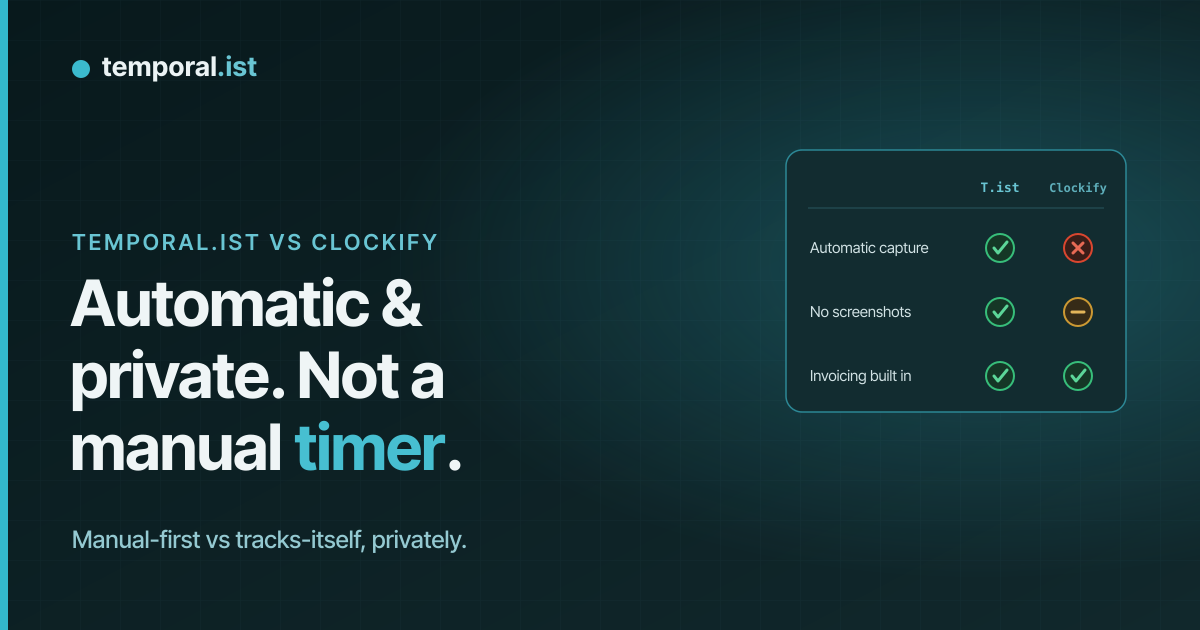
| Automatic time tracking (mechanism)Advantage: Temporal.ist | Automatic by default — matches file paths (desktop) and URL patterns (browser) to projects; no timer to start | Manual timer is the core; an optional desktop Auto Tracker passively logs apps/windows and websites (app-based, not file-based) |
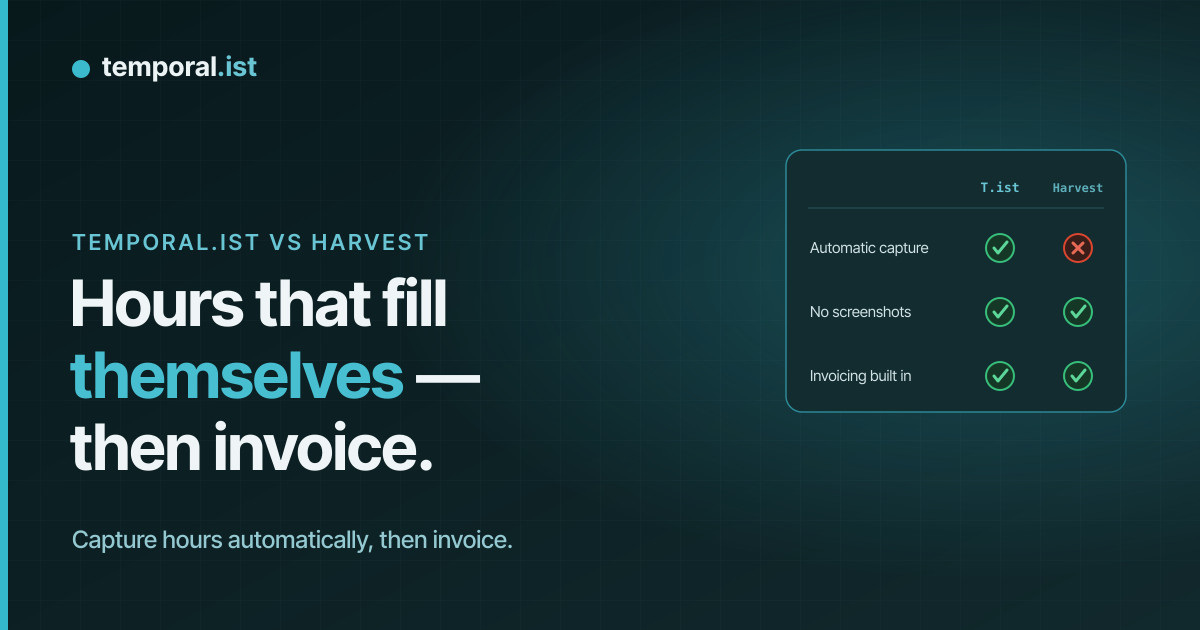
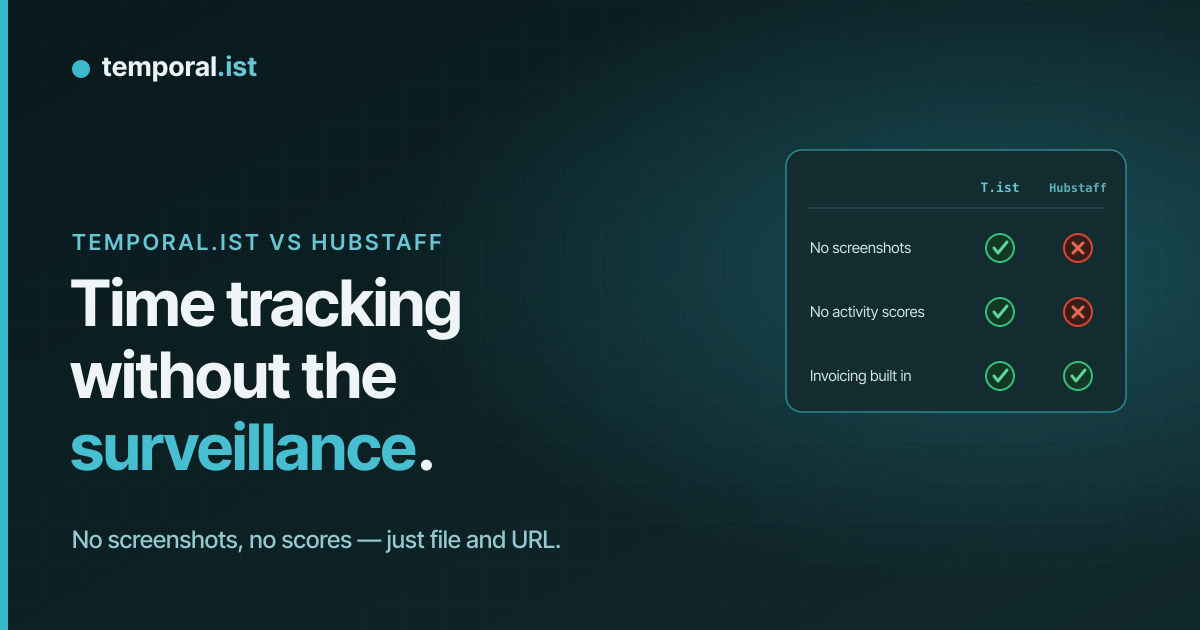
| Screenshots & employee monitoringAdvantage: Temporal.ist | Never — no screenshots, no keystroke logging, no activity or productivity scoring | Optional screenshots, GPS, and activity rates on Pro ($7.99/seat/mo) — surveillance-capable |
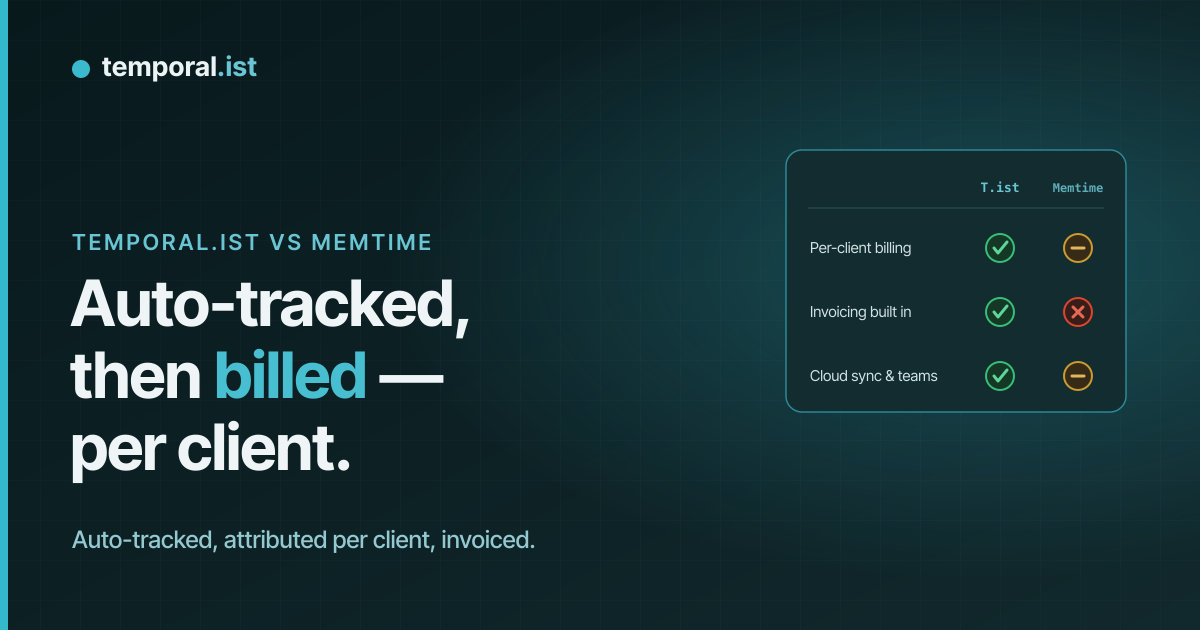
| Built-in invoicingTie | Yes — per-client rates, currencies, tax, PDF export, auto-numbering (ORG-YYYYMM-XXXX), draft/sent/paid/overdue | Yes — from the Standard plan ($5.49/seat/mo) |
| Integrations & ecosystemAdvantage: Clockify | Few — newer ecosystem (browser extensions, desktop client, public v1 API) | Large — dozens of integrations (Jira, Asana, GitHub, Trello, QuickBooks, and more) |
| Reporting & analyticsAdvantage: Clockify | Time-distribution donut, activity bars, project breakdowns, daily timesheets, CSV/PDF reports | Deeper reporting, scheduled exports, approvals, custom dashboards, plus payroll & scheduling |
| PricingAdvantage: Clockify | Free Solo tier forever; paid Pro & Teams plans (prices not yet public) | Free $0; Basic $3.99; Standard $5.49; Pro $7.99; Enterprise $11.99 (per seat/mo, billed annually) |
| Free planTie | Solo free forever — unlimited folders, no credit card | Very generous free plan — unlimited users & projects (4M+ users on free) |
| PlatformsTie | Desktop (Windows/macOS/Linux/AppImage, self-updating), 4 browser extensions, web dashboard, headless CLI/TUI | Web, desktop, browser extension, plus native iOS & Android apps |
| Mobile appsAdvantage: Clockify | None yet | Native iOS & Android apps |
| Privacy & data residencyAdvantage: Temporal.ist | EU data residency, GDPR-aligned, one-click export + full delete; stores only timestamps + file/URL, never contents | Cloud-based; monitoring features available, so privacy depends on admin configuration |
| Maturity & scaleAdvantage: Clockify | Newer, solo-bootstrapped indie product with a smaller ecosystem | Established product with ~7M registered users and broad enterprise adoption |
Clockify and Temporal.ist both track time and invoice clients, but they start from opposite philosophies. Clockify is a mature, very affordable manual timer with a huge feature set — plus an optional Auto Tracker and screenshots that make it surveillance-capable. Temporal.ist is a newer, privacy-first tool that tracks automatically by matching file changes and URLs to projects, and never takes screenshots or scores productivity. This is an honest look at where each one genuinely wins.
When to choose Temporal.ist
Choose Temporal.ist if you bill knowledge work — code, writing, design, research — and you don't want to remember to start a timer. It attributes time automatically by matching the files you edit and the URLs you visit to the right project and client, then turns those billable sessions into invoices without leaving the app. It's the better fit when privacy is non-negotiable: no screenshots, no keystroke logging, and no productivity scores — only timestamps plus which file or URL, backed by EU data residency, GDPR alignment, and one-click export or full delete. It also shines for developers and freelancers who want desktop coverage across Windows, macOS, Linux and AppImage, browser extensions on every major browser, and even a headless Linux CLI/TUI — all working offline and syncing later.
When to choose Clockify
Choose Clockify if you want a proven, low-cost timesheet platform with the broadest feature set. With around 7 million registered users it is far more mature than Temporal.ist, its free plan is famously generous (unlimited users and projects), and its paid tiers are inexpensive at scale — Basic at $3.99, Standard at $5.49, Pro at $7.99, and Enterprise at $11.99 per seat per month billed annually. It's the stronger pick if you need native iOS and Android apps, dozens of integrations with tools like Jira, Asana and QuickBooks, scheduling and payroll, approval workflows, or — for teams that genuinely require it — optional screenshots and GPS monitoring. If your team is comfortable starting timers manually and values ecosystem breadth and mobile over automatic, privacy-first tracking, Clockify is hard to beat on price and depth.
Side-by-side
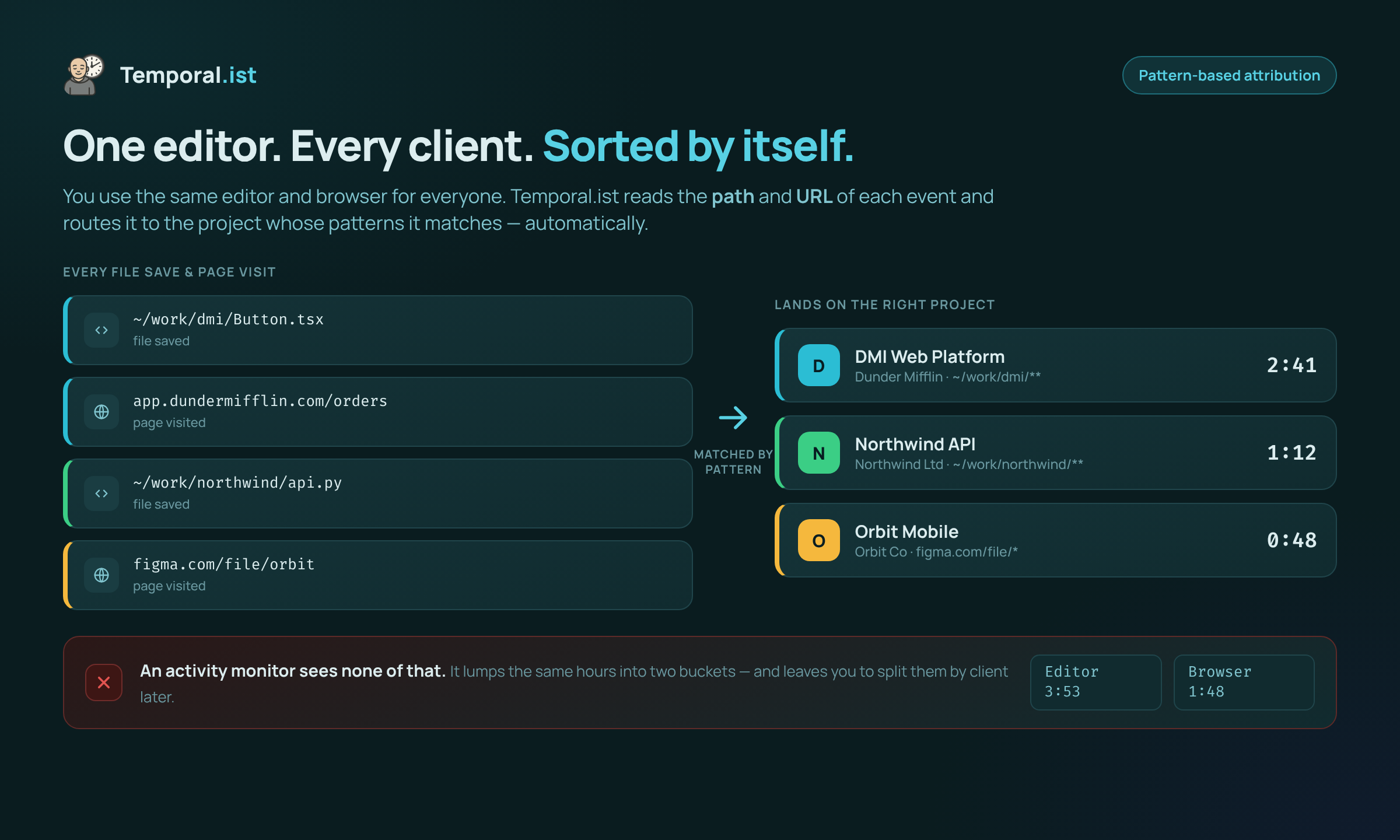
Time is attributed to the right project by file path and URL — no manual tagging.
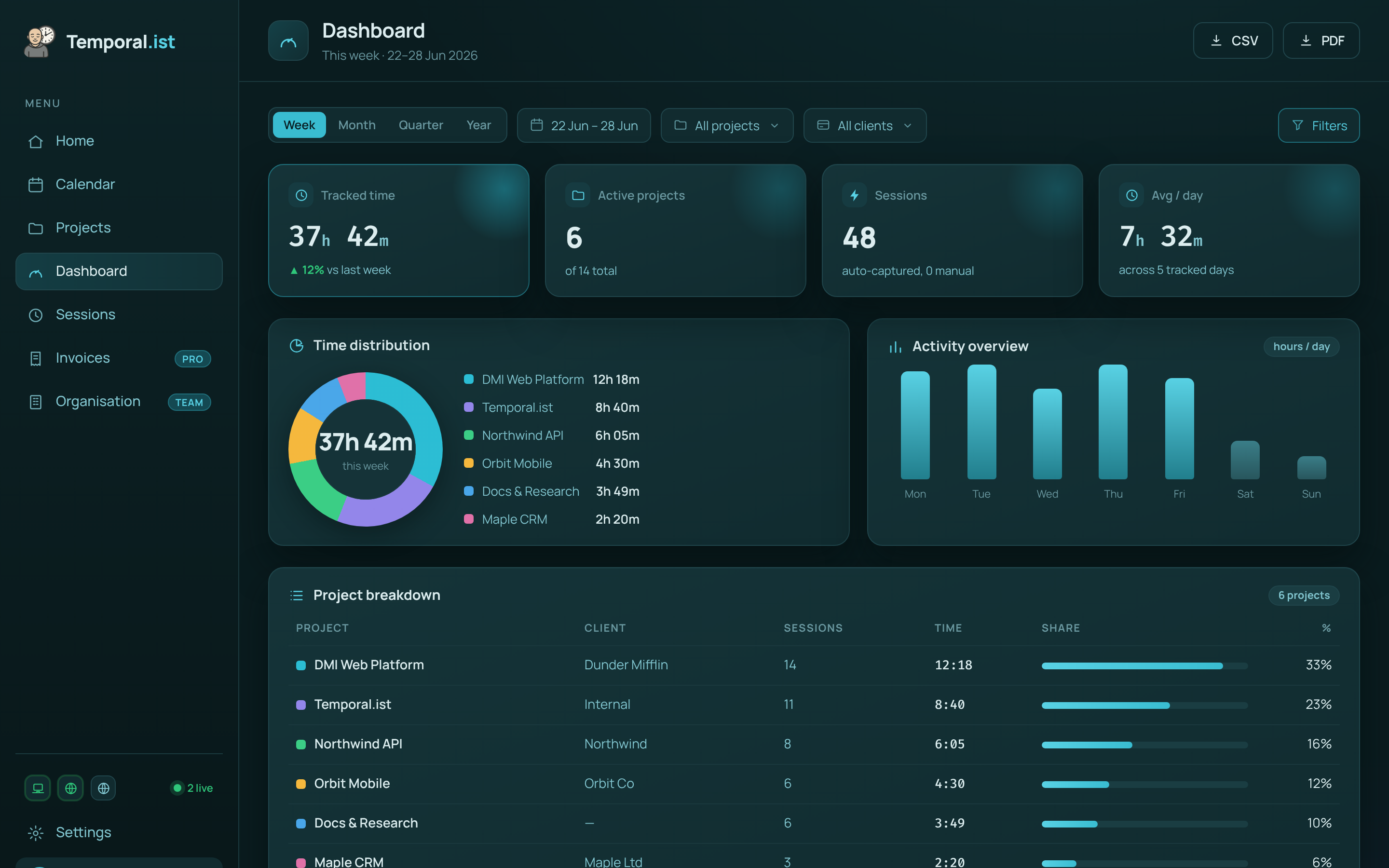
Hours are captured automatically and roll up per project and client, ready to invoice.